
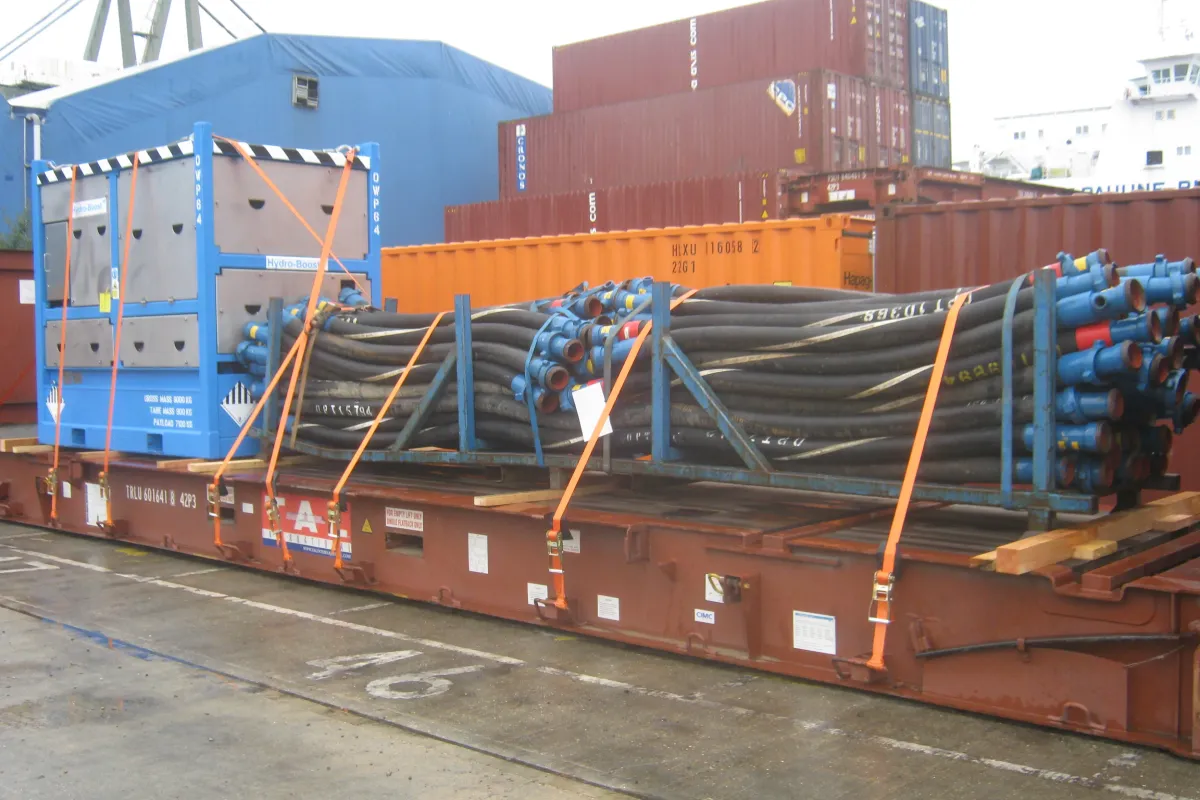
Flat Racks Romford
Flat racks are used when cargo is too wide, too tall, too long, or awkwardly shaped for a standard box. In Romford, that often means plant, machinery, steel, timber packs, modular sections, generators, and other freight moving through local yards, construction sites, engineering firms, and export chains linked to East London and Essex.
If you are comparing formats, a standard enclosed unit may suit secure storage better, while a flat rack is built for oversized loading and lifting. For short projects, container hire in Romford is usually the simplest route. For repeated use, stock holding, or export work, container sales in Romford can be the better option. If the move is already planned, check container delivery in Romford early, because access and lifting space often decide what can be supplied.
- Best for cargo that must be loaded from above or from the side
- Useful when doors are not the main issue, but width and lifting are
- Common on construction, engineering, plant, and export jobs
- Needs a clear lift plan, secure tie-downs, and suitable ground for placement
What a flat rack is and when it fits
A flat rack is a container frame with a heavy-duty base and end walls that may be fixed or collapsible. It has no side walls and no roof, so it gives open access for oversized cargo. That open design is the main reason it is chosen for freight that cannot pass through a standard container door or cannot fit within a standard internal width.
The main decision is not only the cargo footprint, but also how it will be loaded, restrained, and moved. If a machine has to be rolled on, the loading bay must match the chassis height and the trailer position. If a load can only be lifted from above, the site needs crane or reach stacker access. If the cargo projects beyond the frame, the projection must be measured carefully before booking transport or export space.
Flat racks are often preferred for:
- Excavators, access equipment, and site plant
- Steel sections, pipe bundles, and timber packs
- Generators, compressors, and power units
- Modular frames, large crates, and industrial assemblies
- Export cargo that needs open loading and strong lash points
If the load is ordinary palletised freight, a standard 20ft container or 40ft container may be simpler. You can compare those sizes on the 20ft container and 40ft container pages.
Choosing the right size and type
Flat racks are normally supplied in 20ft and 40ft footprints. A 20ft flat rack is around 6.06m long and 2.44m wide. A 40ft flat rack is around 12.19m long and 2.44m wide. The end walls fold down on collapsible versions, which reduces return height and can make collection easier.
Size choice depends on the cargo shape as much as the cargo weight. The important measure is not only the longest point, but the full transport envelope, including straps, dunnage, corners, and any parts that sit proud of the main body. A rack that is too short may still be unusable if the load needs more lashing space. A rack that is too long can create unnecessary handling and route constraints.
Typical size selection
- 20ft flat rack for compact machinery, shorter steel sections, and plant that needs a strong base without a long overhang
- 40ft flat rack for longer modules, pipe runs, frames, and loads that need a larger footprint for distribution of weight
- Collapsible end flat rack when return transport and stackability matter
- Fixed end flat rack when the cargo needs more end support during handling
Tare means the empty weight of the unit, and payload means the maximum cargo weight it can carry within its approved limit. Both matter when the freight is heavy, because the combined vehicle and cargo weight must stay within the transport plan and road limits.
If the cargo must be wheeled inside a box and locked away, a flat rack is usually the wrong format. If the cargo needs open access, strong corners, and better lifting options, it is often the right one.
Hire versus buy, and what condition grades mean
Hire suits projects with a clear end date, such as a plant move, a one-off delivery, or a short export programme. Buy suits ongoing site use, repeated shipping, or yards that need permanent lifting and storage frames. Acorn Containers can support both routes, but the right choice depends on how often the rack will be used, where it will be kept, and whether the cargo profile changes from job to job.
One-trip means the unit has made a single cargo movement from the factory and is usually close to new. It is a common buying choice when the customer wants cleaner steel, more predictable condition, and less repair history. Cargo worthy means the unit is structurally fit for transport and use, although it may show more wear. IICL means an inspection standard used by container lessors and repair depots, with tighter repair requirements and closer condition control.
In practice, condition affects more than appearance:
- Deck wear can affect how well timber dunnage sits
- Bent lashing points can slow or weaken restraint work
- Rust around hinges and corners can increase inspection time
- Missing or damaged markings can delay export checks
- Repair history can affect how much pre-use checking is needed
The term wind and watertight means the unit keeps weather out through its walls, roof, and doors. That matters for enclosed containers, but flat racks are open by design, so cargo protection depends on wrapping, sheeting, packing, and the loading plan rather than sealed steel sides.
Delivery, access and placement in Romford
Romford sits on busy freight routes between Havering, East London, and Essex. The A12, A127, and M25 all influence timing and route choice, and local industrial estates can have tight turning space, parked vans, overhead services, and narrow site entrances. That matters more for a flat rack than for many other container types because the load often needs a crane, forklift, or other handling equipment at both ends of the move.
Delivery method should be agreed before the unit is booked. A hiab, which is a lorry-mounted crane, can place some units where the ground is clear and the reach is suitable. A skeletal trailer may be right where the customer has its own lifting gear. Loaded flat racks often need more detailed offload planning than empty units because the cargo itself may need to stay on the frame during the final lift.
Check these points before delivery:
- Gate width and turning room for the truck
- Clear approach without parked vehicles blocking access
- Ground that is firm, level, and able to support the vehicle and cargo
- Overhead cables, branches, canopies, and low eaves
- Any height, weight, or access restrictions on the route
- Whether the cargo needs crane offload, forklift offload, or side access
For vehicle planning, the Department for Transport guide Lorry Types and Weights is useful for understanding gross vehicle weight limits and common vehicle combinations. The point is practical. If the site only has a short drive, weak ground, or limited turning, the delivery vehicle may need to be smaller or the drop may need to happen at a different point.
Where cargo is moving to Tilbury, London Gateway, or another port, the same access checks apply in reverse. The return collection can be more difficult than the outbound drop if the load has been added to, wrapped differently, or moved to a different part of the yard.
Security, condensation and maintenance
A flat rack is not naturally secure in the way an enclosed container is secure, because the sides are open. Protection depends on the cargo and the site. In Romford and the surrounding industrial corridors, many yards are visible from busy roads or shared access points, so it is sensible to assume that anything loose or lightly packed needs extra restraint.
Good security practice includes:
- Chains, rated straps, or both, fixed to approved lashing points
- Edge protection where straps could cut into timber or packaging
- Tamper evident seals on enclosed crates loaded onto the rack
- Lighting, fencing, and CCTV where the unit is stored on site
- Removal of loose accessories once the cargo has been loaded
Condensation is usually less of a problem on an open flat rack than in a sealed container because air can move freely. The risk does not disappear. Wrapped machinery, timber packs, or sheeted cargo can still trap moisture, especially if the wrapping is airtight or if the load comes in cold and sits through a damp night. For metal cargo, use dunnage to lift the load clear of standing water and check whether protective film or breathable covers are better than a tight wrap.
Maintenance should be simple and regular. Check the base frame, corner castings, lashing rings, end wall hinges, and deck condition before every use. If the unit is hired, report bent sections or damaged timber straight away so the replacement plan does not fail at loading time. If the unit is owned, keep a basic inspection record so that future sales, hire, or export work is easier to document.
Export compliance and freight paperwork
Flat racks are common in export work because they allow secure restraint of irregular cargo. That said, export acceptance depends on more than the steel frame. The cargo must be measured correctly, the weight must be declared correctly, and the lashing method must be fit for the route and the vessel. If cargo overhangs the frame, the carrier needs to know that before booking, not after the truck arrives at the port.
CSC plate means the safety approval plate fixed to a container after structural testing under the international Convention for Safe Containers. For sea freight, that approval matters because shipping lines and terminals use it to confirm that the container type is acceptable for transport. Official treaty information is published by the IMO.
In practical terms, export checks usually cover:
- Verified dimensions of the cargo and the finished loaded unit
- Gross weight, including the rack, packing, and all accessories
- Lashing plan and any survey or photograph requirements
- Customs and shipping line instructions
- Whether the cargo stays within the port, vessel, and road movement rules
Freight responsibility can also matter if the job involves several parties. BIFA, the British International Freight Association, publishes standard freight liability terms that are widely used in the sector. They help define where responsibility sits between the shipper, haulier, forwarder, and carrier. See BIFA for the standard wording and sector guidance.
If the load is moving on road before export, it also has to stay within the transport plan for bridges, junctions, and local routes. That is especially important around Romford, where industrial access can be good on one part of the route and restricted on another.
How the process works with Acorn Containers
- Send the cargo dimensions, weight, photos if available, and the delivery postcode in Romford or the surrounding area.
- Confirm whether the rack is for hire or purchase, and whether the cargo will be loaded by crane, forklift, or other handling equipment.
- Check access, route constraints, and the final placement point before the vehicle is booked.
- Agree the condition grade needed, such as one-trip, cargo worthy, or IICL.
- Book delivery or collection once the lifting plan and site details are clear.
- Carry out the drop, then inspect the unit, retain the paperwork, and schedule any follow-on support if the cargo plan changes.
The best projects are the ones with accurate measurements before the booking is confirmed. If the load profile is still changing, it is safer to pause and confirm the final dimensions than to force the wrong frame onto the job. That avoids delays at the yard, the port, or the customer site.
Acorn Containers can also support ongoing needs such as hire extensions, collection, replacement units, and advice on whether a flat rack, open top, or enclosed container is the better match for the next movement.
Frequently asked questions
What is the main use of a flat rack in Romford?
Flat racks are mainly used for oversized or awkward cargo that cannot fit through standard container doors. In Romford, that often means plant, machinery, steel, modular frames, and export loads moving through local industrial yards or onto road routes toward ports.
Do I need a crane to load a flat rack?
Often, yes. If the cargo is too heavy or too awkward to roll on safely, a crane, reach stacker, or forklift will usually be needed. The loading method should be agreed before delivery so the correct vehicle and site space can be arranged.
Is hire or purchase better for a flat rack?
Hire is usually better for short projects, one-off exports, or temporary plant moves. Purchase is usually better when the same type of oversize cargo is handled regularly, or when the frame will stay in one yard and be reused often.
What condition grade should I choose?
Choose one-trip if you want a near-new unit with minimal wear. Choose cargo-worthy if the frame must be structurally sound for transport and you are less concerned about cosmetic marks. Choose IICL if you want a tighter inspection standard and more consistent repair quality.
Can a flat rack be delivered to a Romford industrial site with limited access?
Sometimes, but access must be checked first. Gate width, turning room, ground condition, overhead obstructions, and the ability to unload safely are all important. Sites near busy roads or with shared parking usually need more planning than open yards.
Does a flat rack protect cargo from weather?
Not in the same way as an enclosed container. Flat racks are open by design, so weather protection depends on the cargo wrap, sheeting, packing, and the route plan. For some loads, an open top or enclosed container may suit better.
What information should I send when asking for a flat rack in Romford?
Send the cargo length, width, height, weight, loading method, final postcode, and any route or site restrictions. Photos help if the cargo is irregular. The more exact the information, the easier it is to match the right frame and delivery method.
